
Genitals
These illustrations are schematic diagrams of genitalia, and do not reflect their real-life diversity. The appearance of the genitals varies from person to person.
Vulva
The external genital organs consist of the vulva, which includes the inner and outer labia, the vaginal opening and the visible part of the clitoris.
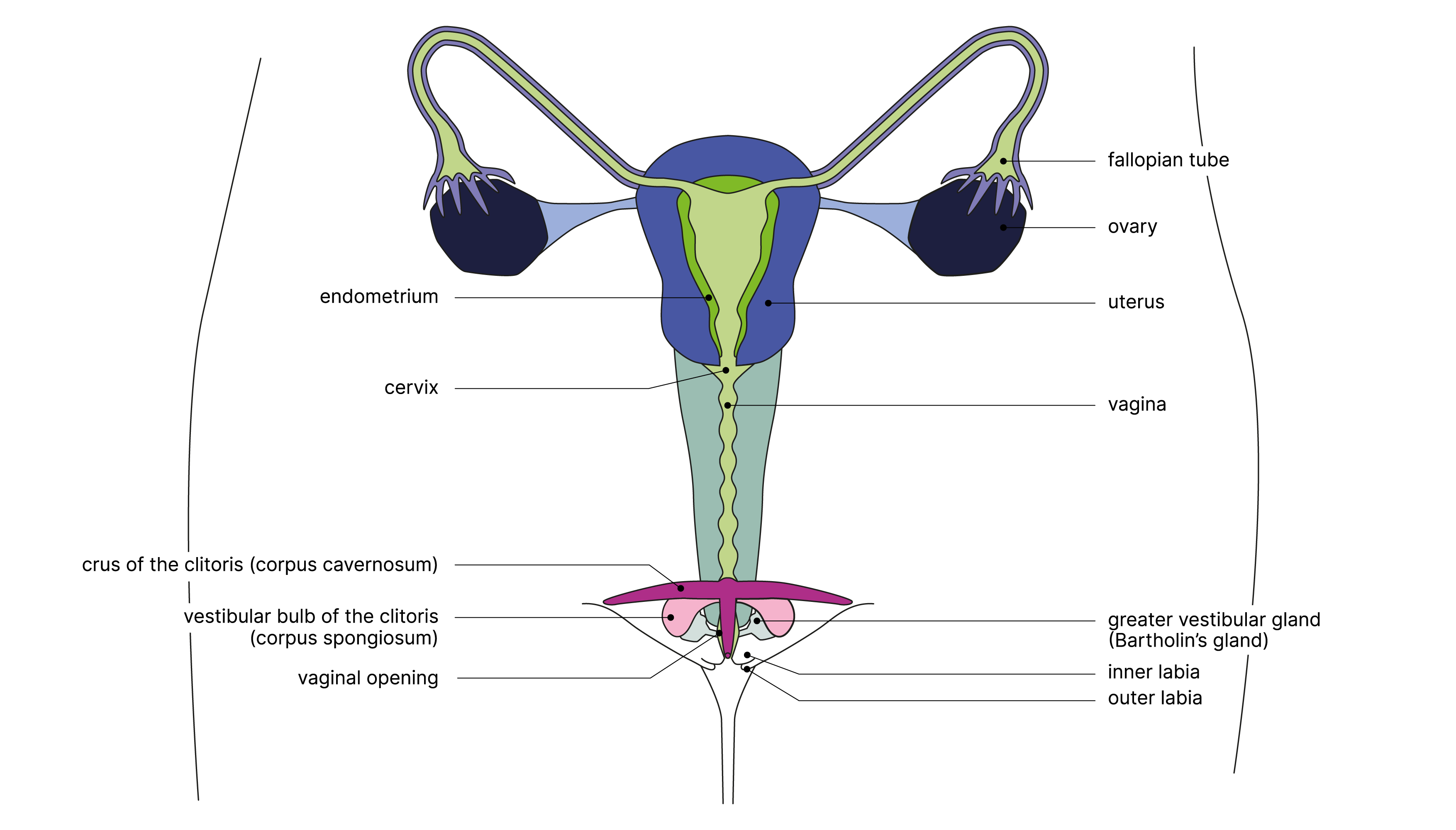
Inside the body are the uterus, ovaries, fallopian tubes, vagina and some glands.
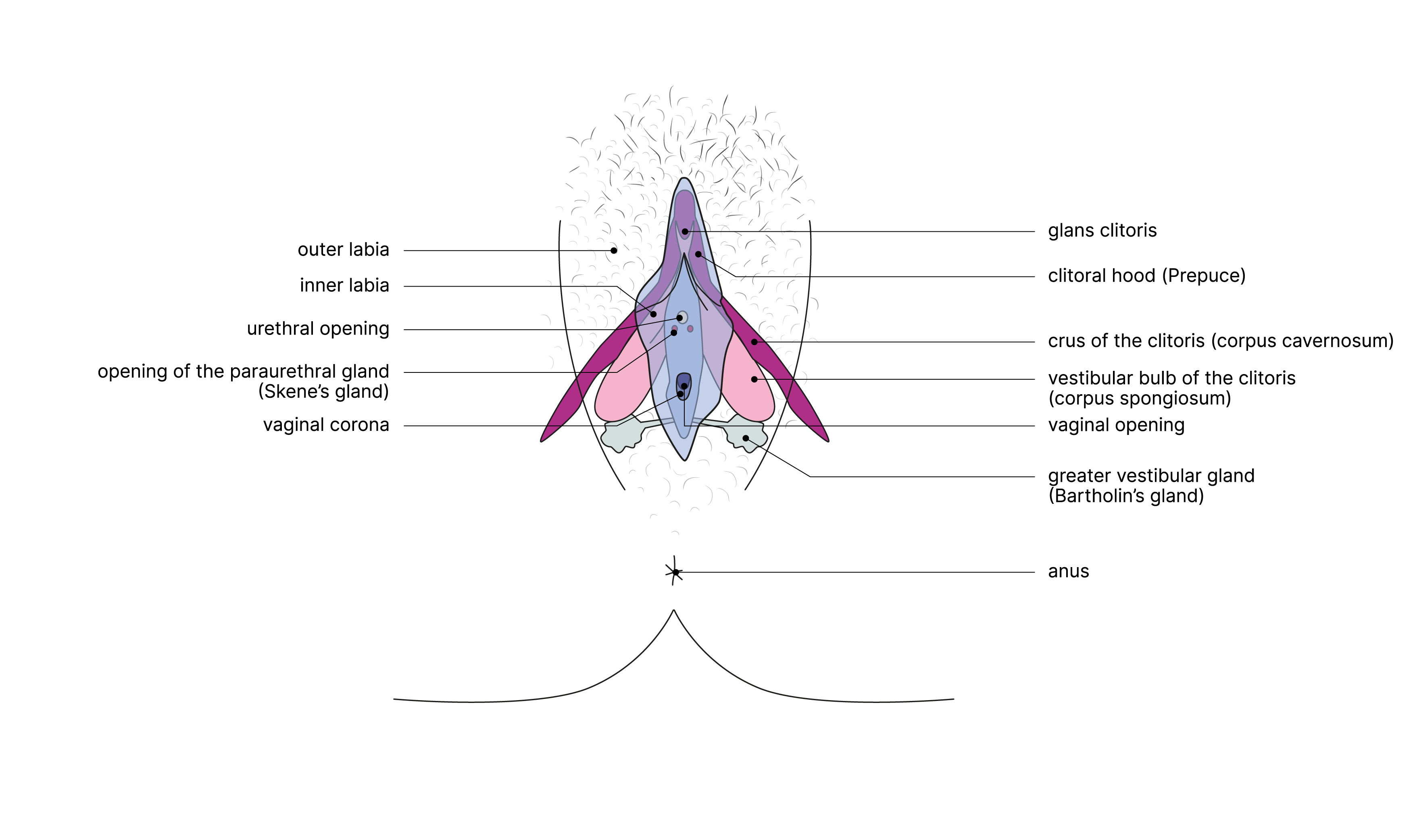
Every vulva is unique, and varies from person to person. The vulva consists of:
Outer and Inner Labia
The appearance, colour and size of the labia can vary from person to person, as well as with different movements (e.g. during sexual arousal) and age. The two inner labia surround the vaginal entrance and the opening to the urethra. They may extend beyond the outer labia, and can be asymmetrical.
Clitoris
The clitoris (like the penis) is made up of different erectile tissues (the clitoral corpus cavernosum and corpus spongiosum). Only a small part of the clitoris is visible: the glans clitoris and the clitoral hood (prepuce). The clitoral vestibular bulbs (approximately 4 cm long) and clitoral columns (crus) (also around 4 cm long) are located inside the body. The total length of the clitoris is 8 to 12 cm. During sexual arousal, the tissues fill with blood, causing the glans of the clitoris and the erectile bodies to swell and become somewhat firmer (an erection). The only currently known function of the clitoris is related to sexual pleasure.
Urethral Opening
The urethral opening is the tip of a narrow tube (the urethra) that runs from the bladder and allows urine to pass out of the body.
Uterus
The uterus is the shape and size of an upside-down pear. It is made of muscles, and its inner wall is lined with a mucous membrane called the endometrium. This is where the embryo develops during pregnancy, and it is the source of menstruation. The connection from the uterus to the vagina is called the cervix.
Ovaries
The two ovaries are oval in shape and about the size of an almond. They are the glands responsible for producing egg cells. Oestrogen and progesterone (sex hormones) are also produced in the ovaries.
Fallopian Tubes
The fallopian tubes are two mobile, funnel-shaped tubes through which the eggs are transported from the ovaries to the uterus.
Vagina
The vagina is a flexible, stretchy canal between the vulva and the uterus. The vaginal wall is muscular and covered by mucous membranes. The vagina ends at the cervix (the narrow passage between the vagina and the uterus).
Vaginal Corona (formerly Hymen)
The vaginal corona is a thin, open membrane that follows the contours of the vaginal entrance. The opening, shape, and elasticity differ from person to person. For some people, the first experience of penetrative sex may cause small tears in the vaginal corona, leading to bleeding, but this is not always the case. Therefore, neither the appearance of the vaginal corona, nor the presence or absence of bleeding indicates whether a person has previously had penetrative sex.
Note: In very rare cases, the vaginal corona is completely closed, and a surgical procedure is required to create an opening.
Greater Vestibular Glands (Bartholin’s Glands)
These are two pea-sized glands located on either side of the vaginal entrance. They secrete a fluid that moistens and lubricates the entrance to the vagina.
Paraurethral Glands (Skene’s Glands)
The paraurethral glands, considered the female equivalent of the male prostate, are located around the urethra. They secrete a fluid that enters the urethra and flows through two small ducts on either side of the urethral opening.
G-Zone (G-spot)
The “G-zone” is a term often used to describe an area on the front wall of the vagina that is in contact with the internal parts of the clitoris. This is a large area, not an isolated spot, and it is known to be particularly sensitive. Stimulation of this area can be pleasurable, and may lead to sexual arousal, orgasm and even ejaculation (“squirting”).
Anus
The anus is the opening that connects the intestine to the outside of the body. The anus is also a sensitive area that can produce sexual arousal.
Penis
The external genital organs consist of the penis and two testicles, which are enclosed within the scrotum.
The vas deferens (sperm duct), the prostate and the seminal vesicles are located inside the body.
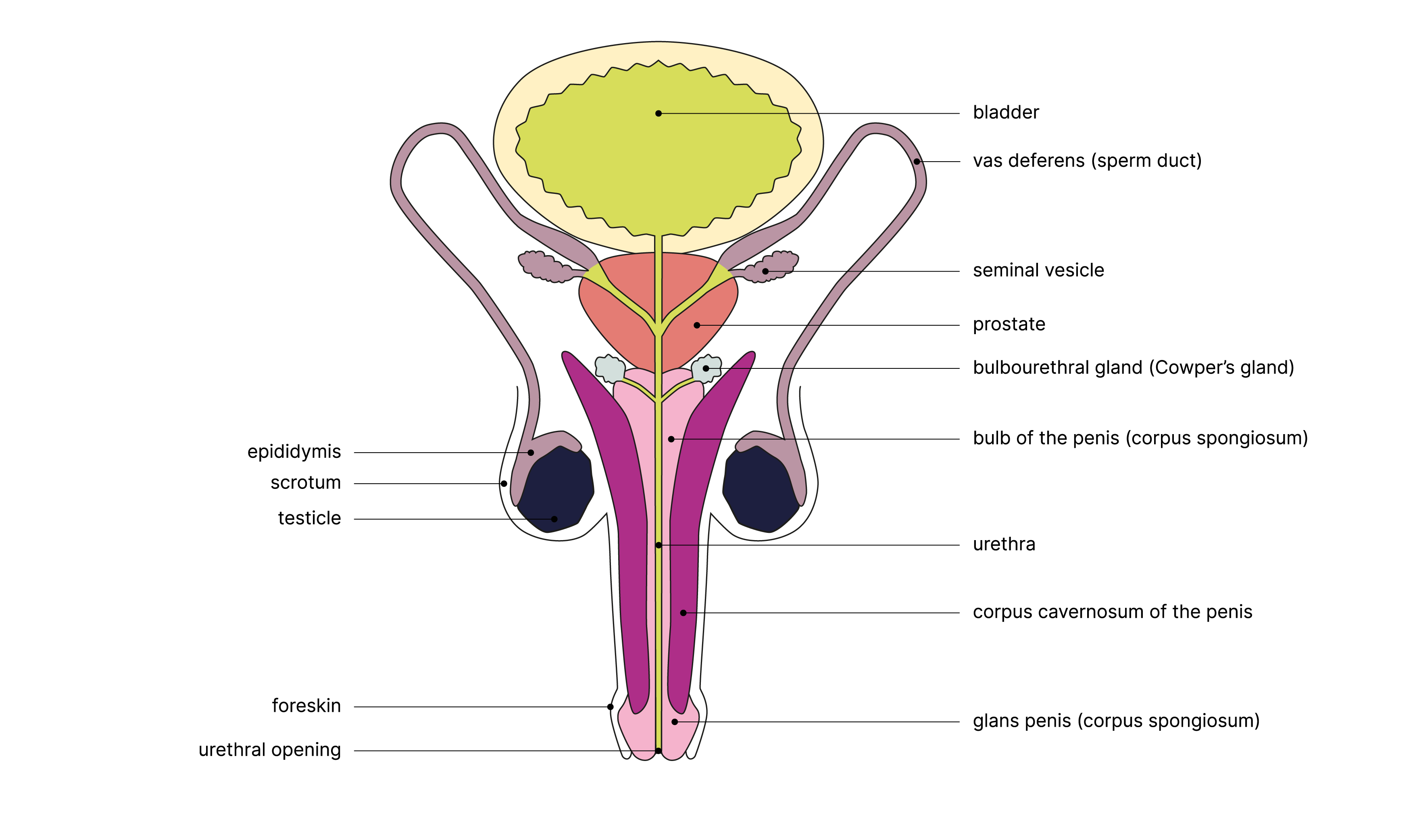
The penis is (like the clitoris) composed of various erectile tissues (corpus cavernosum and corpus spongiosum). These tissues fill with blood during sexual arousal, causing the penis to become erect (an erection). During ejaculation, the muscles surrounding the erectile tissues contract and semen is expelled from the penis. The amount of semen produced varies from person to person and from one ejaculation to another. An ejaculation is often accompanied by a feeling of pleasure (orgasm), but this is not always the case.
Glans Penis
The glans penis is the area at the tip of the penis. It is very sensitive to touch.
Foreskin
The foreskin is a small fold of skin that covers and protects the glans penis. It is very sensitive to touch. The foreskin should retract equally well when the penis is both hard (erect) or soft (flaccid).
Notes:
The surgical removal of the foreskin is called circumcision. This procedure may be performed for religious or socio-cultural reasons, and sometimes for medical reasons. As with all procedures affecting the body, everyone has the right to make their own decisions in this regard.
If the foreskin is too tight or cannot be pulled back to expose the glans, this is known as phimosis. If signs of phimosis are present, it is advisable to consult a paediatrician or general healthcare professional.
Urethral Opening
The urethral opening is the end of a narrow tube in the penis (the urethra) that runs from the bladder and allows urine to pass out. Pre-ejaculatory fluid (“pre-cum”) and semen are also expelled through the urethra. Urine and semen can never flow out of the urethral opening at the same time.
Testicles
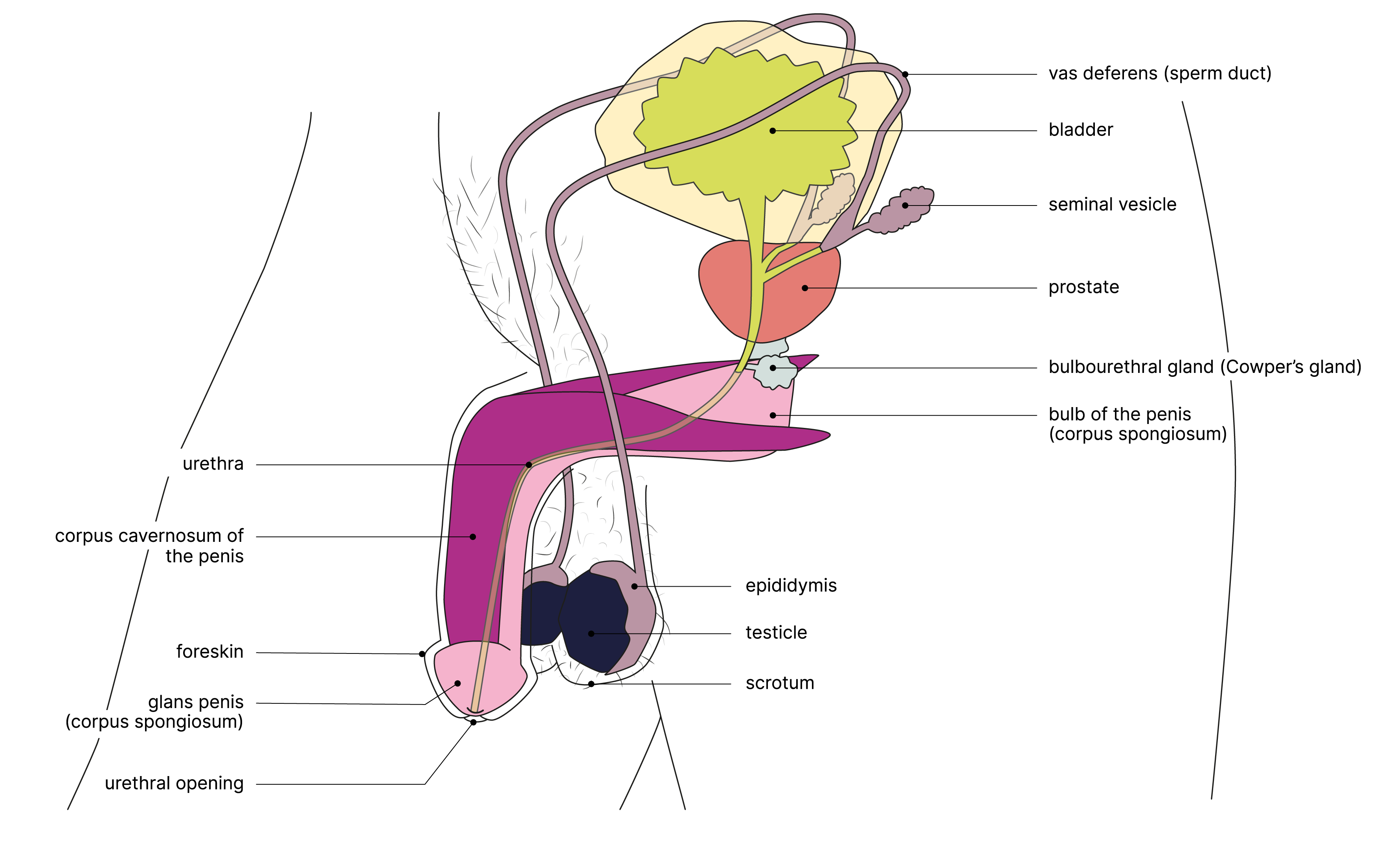
The testicles produce sperm (about 2,500 sperm per second) and testosterone (a sex hormone). The appearance and size of the testicles vary from person to person. It is normal for the two testicles not to be exactly the same (in terms of size, thickness or height).
Epididymis
The epididymis is a coiled tube system that serves as a storage site for sperm.
Scrotum
The scrotum is a pouch of skin that houses the testicles and epididymis.
Bulbourethral Glands (Cowper’s Glands)
The bulbourethral glands are two pea-sized glands. During arousal, they release a small amount of a thick, clear secretion into the urethra. This secretion cleans and lubricates the urethra before ejaculation. This fluid, which may contain sperm, sometimes appears as a clear drop at the tip of the glans. It is also known as pre-ejaculatory fluid or “pre-cum”.
Prostate
The prostate secretes a fluid that protects sperm from bacteria and helps them to move after ejaculation. It is a sensitive gland and its stimulation can produce sexual arousal.
Seminal Vesicles
The seminal vesicles are genital glands. They produce seminal fluid that makes up the majority of the volume of semen. This seminal fluid is passed into the vas deferens and then travels through the prostate.
Vas Deferens
The two vas deferens (or sperm ducts) transport sperm and connect the epididymis to the prostatic urethra. Sperm and seminal fluid travel through these ducts. The sperm are then directed into the urethra. Once in the urethra, the mixture of sperm, seminal fluid, and prostatic secretions forms what is known as semen.
Anus
The anus is the opening that connects the intestine to the outside of the body. The anus is also a sensitive area that can produce sexual arousal.
The right to make choices about your own body
Everyone has the right to make decisions about their own body. Unnecessary medical procedures on the genital area are prohibited if the person concerned is capable of giving informed consent and refuses them. Female genital mutilation (FGM) is the term for the partial or complete removal of the external female genitalia for non-medical reasons. It can be performed in many different ways, and the age of the person when it is carried out can vary greatly. Female genital mutilation is illegal in Switzerland as well as in most other countries.
If you have any questions or need support, you can visit https://www.excision.ch/.
Information
Written by: 2025, SANTÉ SEXUELLE SUISSE (The Swiss Sexual Health Foundation), ALECSS, (the Association of Sexual Health Specialists in French and Italian-speaking Switzerland - Education - Training - Advice) and faseg, the Specialist Association for Sexual Health in Counselling and Education.
Medical copy editing of the original text (French): Dr Sara Arsever (University of Geneva, HUG), Dr Céline Brockmann and Maéva Badré (Bioscope, UNIGE)
Medical copy editing of the translation (English): Dr. Julius Obinna Ugwu, MD (Doctor of Medicine)
Content produced with support from the Swiss Federal Office of Public Health (FOPH)